
Effective 1:1 Meeting Template
Learn how to structure 1:1s that develop people through clarity, continuous feedback, and practical actions.
William Zimmermann
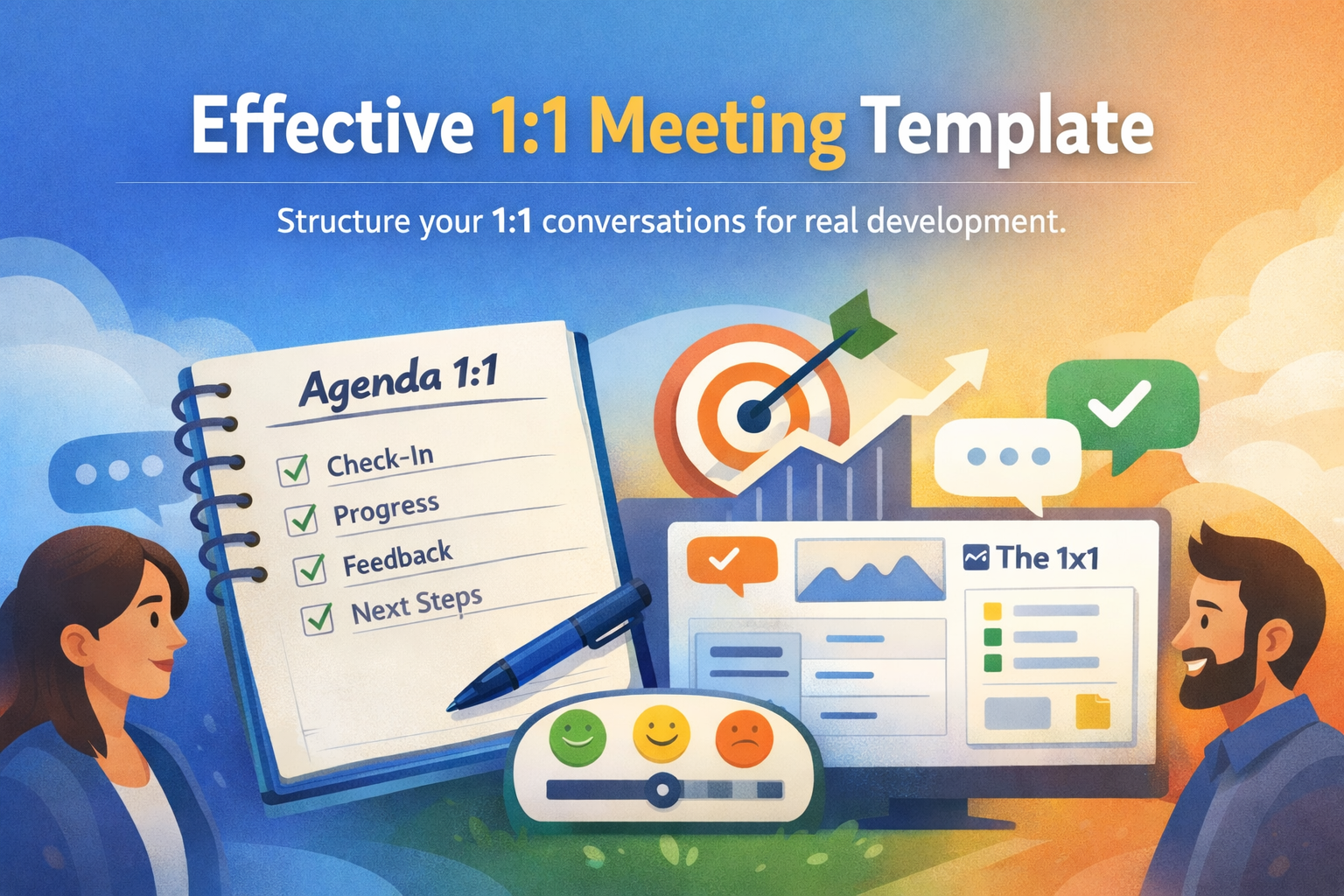
1:1s are one of those simple ideas everyone thinks they already does well — until many of them become improvised, repetitive, or purely operational conversations.
When done well, 1:1 meetings create trust, clarity, and continuous growth. When poorly structured, they turn into “just another calendar invite.”
In this article, you will find:
- Best practices to run effective 1:1s
- A simple agenda template you can use today
- And, for those who want something more robust, how The 1x1 can make this process consistent and measurable
What makes a 1:1 truly effective?
A 1:1 is not:
- A status meeting
- A task report
- An improvised check-in “to see how things are going”
A great 1:1 is a safe, recurring space where the employee can:
- Speak openly
- Reflect on challenges
- Receive continuous feedback
- Grow with clarity
And the leader’s role is not to talk more — it’s to listen better.
In practice, this only works when there is at least a minimal structure.
Ideal frequency for 1:1s
There is no absolute rule, but practice shows some healthy patterns:
- Weekly: new teams, onboarding, or critical roles
- Biweekly: most mature teams
- Monthly: only in very specific cases (and even then, with risk)
More important than frequency is regularity. Canceling or postponing 1:1s frequently sends a silent message: “this is not a priority.”
Simple 1:1 agenda template (30 to 45 minutes)
Below is a straightforward template, tested and easy to adapt. It can be used on paper, Notion, Google Docs — or inside a dedicated tool.
1. Human check-in (5 minutes)
Start with the obvious — which rarely happens:
- How are you today?
- How was this past week for you?
- Anything outside of work affecting your focus or energy?
This moment creates context. People don't arrive "neutral" to meetings.
2. Progress and obstacles (10–15 minutes)
This is not a detailed task status, but reflection:
- What moved forward well since our last conversation?
- Where did you feel the most difficulty?
- Any blockers I can help remove?
The focus is learning, not pressure.
3. Two-way feedback (10 minutes)
This is the heart of the meeting.
From the leader to the employee:
- Something positive you observed
- One clear improvement point (with examples)
From the employee to the leader:
- What can I do better as your manager?
- Any decision or process that is getting in the way?
Without recurring feedback, small frustrations become big problems.
4. Development and next steps (5–10 minutes)
End by looking forward:
- What would you like to develop in the next few weeks?
- Any specific skill, responsibility, or goal?
- Define 1 or 2 concrete actions, no more than that
These actions are what turn conversation into real progress.
5. Clear wrap-up (2 minutes)
Before ending:
- Reinforce the next steps
- Confirm responsibilities
- Schedule the next meeting (simple, but crucial)
The downside of doing this “manually”
This template works very well — up to a point.
Over time, common challenges appear:
- Notes spread across different places
- Difficulty remembering what was agreed weeks ago
- Lack of history to see growth (or stagnation)
- A feeling that every meeting starts from zero
That’s when many leaders give up on structure… or start doing superficial 1:1s.
When a dedicated tool makes a difference
If you want to take 1:1s seriously as a leadership practice, a specialized tool helps you:
- Centralize meeting history
- Track actions and commitments over time
- Use consistent, well-crafted questions
- Visualize growth, mood, and patterns
- Save time on preparation and documentation
That’s exactly why The 1x1 was created.
How The 1x1 helps in practice
With The 1x1, you can:
- Create reusable meeting agendas
- Record structured notes per meeting
- Define and track action items
- Keep a complete history per employee
- Get a clear view of progress over time
All in one place, without scattered spreadsheets or forgotten documents.
No credit card required.
Conclusion
1:1s don’t need to be long, complex, or bureaucratic.
But they do need to be intentional.
A good template already changes a lot.
A good system turns that into culture.
If you want to move beyond improvisation and build conversations that truly develop people, the path starts with structure — and is sustained with consistency.
Leadership is not about remembering everything.
It’s about creating systems that take care of people as the team grows.
Related Posts
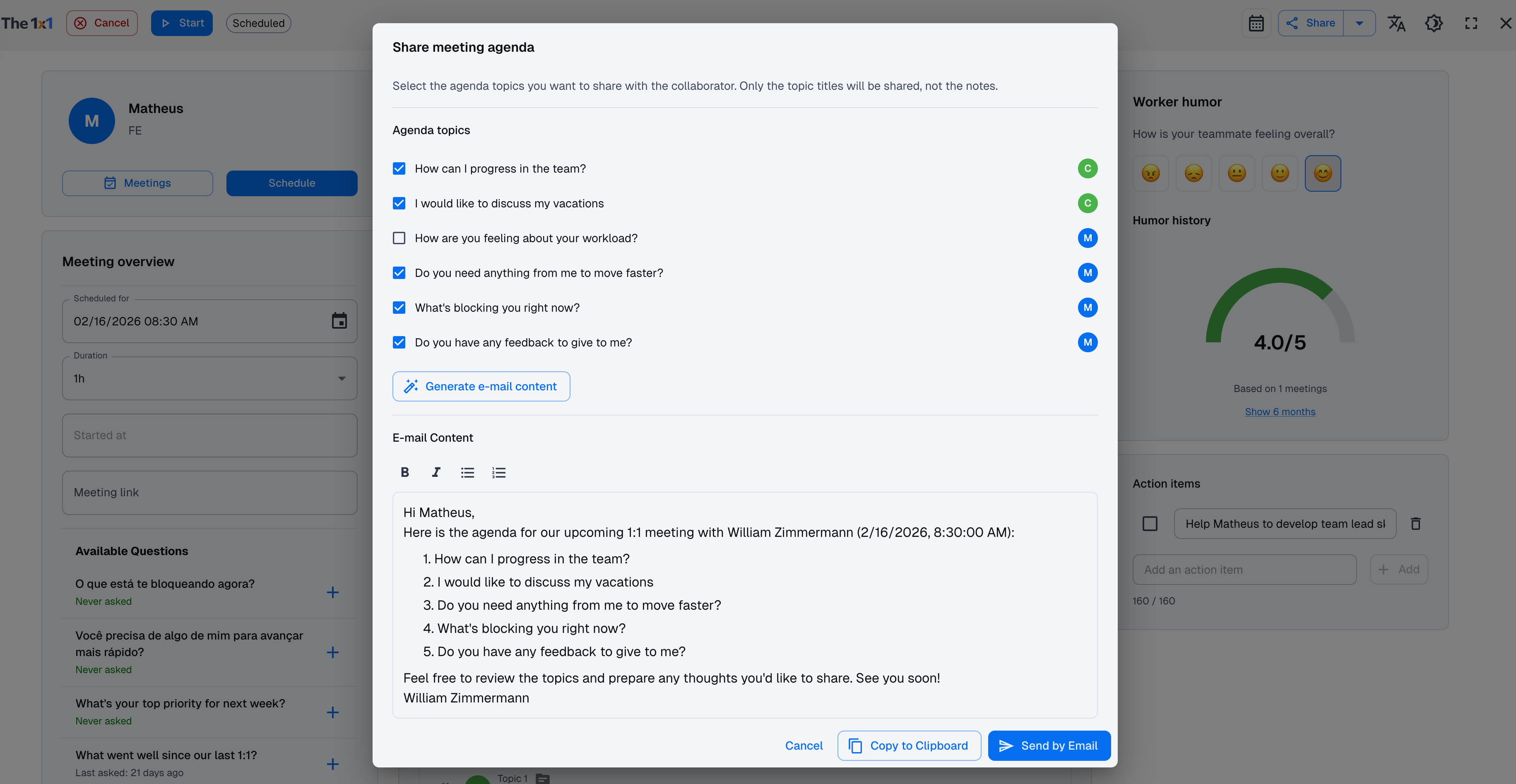
Sharing 1:1 meeting agendas and notes: best practices for leaders who want clarity, focus, and continuous growth
Learn why sharing the 1:1 agenda before the meeting and the notes after it creates alignment, accountability, and better follow-up.

What Is a 1:1 Meeting?
Understand why the 1:1 is the most important conversation between a leader and a teammate — and how to make it work.
Great 1:1s aren't status updates. They're people accelerators.
Effective one-on-one meetings are not about reporting tasks or micromanaging work. They exist to build clarity, trust, and human progress.